Showing posts with label data journalist. Show all posts

Tuesday, 6 March 2012

How to: design an effective journalism blog

Video guide of the basics of designing a blogspot page: more tutorials by wvteks available here.

When designing a blog to present journalistic work there are certain elements that need to be included in its construction. These elements include:

A strong layout
One blog user suggests on Blogntrepreneur that:
"There is a golden rule when it comes to page layout in design, which is that everything on the page should be there for a reason. This same rule should apply to your blog. So to do this, remove anything unneccessary on your blog."
To achieve this it is important that you have in mind what messages you want your blog to contain. In this blog it is important that the content is clear and straight to the point so by having only one column and no widgets this look has been achieved. Additionally added a page banner at the top of the content still maintains a simplistic look but adds organisation to the content and interlinks with the content. Blogger as a blog creator allows the user to add additionally widgets and columns but always bear in mind  how this will affect your blogs aesthetic.


Tags
One blogger user stated that:
Tags not only allow people and search engines to find your content easier, but they can also help you organize your site
Tags are an important way to organise content as well as improve the chances of your blog being noticed. In this blog tags have sometimes included Twitter tags that link to the online promotion techniques being employed. Additionally these tags directly link to the pages at the top of the page e.g. data journalist adding an organisational structure to the blog. The tags you choose to accompany your posts must highlight the important parts of your content and also your blog. 


Copyrighted images
A blog isn't visual enough without strong images that relate to the content, however you can't just take a photograph or image from the internet and put it in your blog you have to acknowledge the graphics origin and copyright. Online images can be bought through websites such as iStockphoto but some images are available for free provided you reference where you got the photo from directly. Flickr is a great example of a website where copyright is important but also a great source of images. There are different levels of copyright under the umbrella of creative commons on Flickr which include:


Attribution:
You let others copy, distribute, display, and perform your copyrighted work – and derivative works based upon it – but only if they give you credit.
Non-commercial:
You let others copy, distribute, display, and perform your work – and derivative works based upon it – but for non-commercial purposes only.
No Derivative Works:
You let others copy, distribute, display, and perform only verbatim copies of your work, not derivative works based upon it.
Share Alike:
You allow others to distribute derivative works only under a license identical to the license that governs your work.
To see this information in more detail with further explanations visit the Creative Commons website.
To get images from Flickr use the search engines and check the creative commons before using an image. For this blog photos are highly important and below is a visual guide to how copyrighted images from Flickr were used in this blog:


Another way to obtain images for a journalism blog is by looking through official companies websites. In this blog the main subject matter was the London 2012 Olympics so by going through their official Olympics websites images are available. With all companies search their sites have press sections that you should search for. In these sections they sometimes have a section for images that you can use on your site which are free of copyright. This is what was used on this blogs header to create a strong visual identifier for the blog and to emphasize what the blog is about. You can find more London 2012 Olympic images through their press site here.

All of these elements need to be considered when making a blog. Think about how you ultimately want the blog to look and use these techniques to show your blogs meaning and style.



Monday, 5 March 2012

Olympic sponsors investigation: Marketing (2)

If you were to visit each Worldwide Olympic partners website you will see a direct reference to their role in the Olympics which are related to their company values and messages. This alongside a long string of marketing campaigns and advertisements promotes individual sponsors and the entire Olympic brand. An official Olympic websites states that marketing is:
"Olympic marketing helps perpetuate the work of the Olympic Movement, by providing resources, programmes and financial support. All programmes and actions of a partner should be designed to enhance and protect the Olympic image and Olympic values"
This can be really explored by looking as specific examples of sponsors and analysing their campaigns. TOP's are the main sponsors of the games and according a news source FT:
"The investment required is a significant one - tier one domestic sponsors of London 2012 pay £50m on average, and worldwide Olympic partners around $100m (£61m)"
Coca Cola 


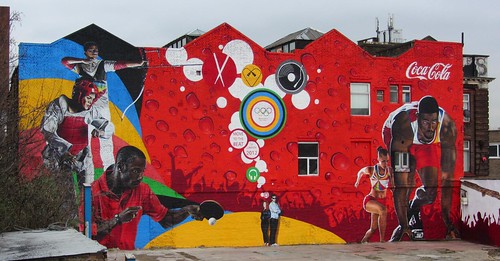
Coca Cola have been sponsoring the Olympics since 1928 and their most current advertising campaigns the presence of their own brand identity as well as the Olympic brand and values, and also athletes (see the examples below - TV advert found through Youtube). Additionally Coca Cola encapsulates and reiterates continually on their website their positive influence on the Olympics and a future past the London 2012 games. An official statement on their Olympic Games page states:
"Coca‑Cola is already working closely with London Organising Committee of the Olympic and Paralympic Games (LOCOG) to understand how we can promote recycling within the venues and are looking at every aspect of our Olympic Games plans - from the uniforms our staff will wear to the type of fridges we use to chill our drinks - to ensure we reduce our environmental impact wherever possible."


Monorex by cocabeenslinky
Monorex, a photo by cocabeenslinky on Flickr.
As you can see from these examples Coca Cola infuses its brand (bright red, vibrant, exciting) with the Olympic values and athletes. These variety of advertising campaigns correspond and follow the values the London 2012 Olympics wants to portray as the say on their website
"London 2012 will create the most accessible and participative Games. It will touch people as it has never done before, stimulating people to do more and to try new things and reassess what we are all capable of. London 2012 has sport at its heart and London at the centre, but it is more than London and more than sport. It is a Games for London, the UK and the rest of the world, for sport and culture, for volunteers and business."
However some their marketing campaigns have met criticism, for example on Flickr one user said in regards to cocabeenslinky's photo:

"It should never have been there. What was there before was so much greater"

Despite this the marketing campaigns have been successful with their Youtube channel having over 60,986,548 views (as of 23:52pm on 05/03/2012) with their combination of brand identity, entertainment and celebrity. Being the only TOP to focus on drinks their exclusivity to the games provides a large point of revenue and something their competitors don't have. The only other food and drink company in the TOP's is McDonald's who themselves stock Coca Cola products. 


Coca Cola as a business is fully aware of an evolving global economy and the up rise of social media and technology with their marketing director Claudia Navarro saying in Adage's article published in September 2011 on the release of their advertising campaign:
"We are using London's rich culture and diversity as a backdrop. We've partnered with Mark Ronson because he's someone special - he's a London icon who can bring our creative vision to life. The athletes only met for the first time yesterday, but already they are buddies and are tweeting each other"
This shows an understanding of social media, global relations, creativity and celebrity that each sponsor replicates throughout their Olympic campaigns. 


What kind of companies are represented in London 2012?

Breakdown of companies - Pie chart generated by me through Chartgo
In the previous spreadsheet worldwide partners were categorised by sort of companies they were. From this information a pie chart was generated to visualise percentages and what kind of company was most dominant within this group.

From this pie chart it is apparent that technological companies are the most represented within this selection. This coincides with an innovative perspective the games is trying portray. Additionally there is also a wide selection of other types of companies represented.

So from this further investigation which originated from a culmination of a wide variety of information I was able to find out reasoning behind marketing campaigns, the history of the Olympic games and how all this is all incorporated in certain brands. It is clear that branding both within the companies and within the Olympics is essential to a successful Olympic games if success is measured by a bigger spectacle, consumption, finance and audience satisfaction.


These forms of investigations and visualisations can be replicated to any pieces of information and any investigation by using specific Google searches/Google documents and websites such as GliffyDipity and ChartGo.

Olympic sponsors investigation: Worldwide Olympic partners (1)


Continuing from the spreadsheet generated previously, it is important that you focus on specific elements when conducting further research. For example in this investigation information specifically about TOP and the worldwide partners has become the main point of focus and several forms of visualisation have been generated. In this post, a timeline has been generated to map the progression of worldwide Olympic partners historically. From this visualisation further explanations, visualisations and investigation should be conducted to give your audience the bigger picture. In this case I will use these techniques and tips to explain the investigation of TOP which relates to previous research presented on this blog.

What are Worldwide Olympic partners?

Worldwide Olympic partners also known under The Olympic Partners (TOP) programme was established in 1985 by the IOC. This was based of the product category exclusivity model utilized by Los Angeles 1984 Olympic Games. This initiative created in coordination with 159 NOC's (National Olympics Committee) along with the Seoul and Calgary OCOG's (Organising Committee's of the Olympic Games) both of which also launched independent marketing campaigns. The IOC also required the OCOG to develop a joint marketing programme with the host countries NOC for the first time. This started the relationship between the Olympics and the high budget marketing and sponsorships campaigns.


TOP facts and figures - from www.olympic.org (2009)

This relationship and concept has developed over time resulting in ever increasing revenue from the selected partners. From the graphic provided you can see a correlation between the NOC'S and overall revenue. Additionally it is possible to make certain predictions about the revenue that will come from the London 2012 Olympics. With the London 2012 Olympics having 16 TOP's it could predicted by specialists within the marketing campaigns that a high revenue will be achieved. With the figures behind the cost of being an Olympic sponsor, in regards to London 2012, being heavily protected by LOCOG and other respective companies it is impossible to draw a correlation between spending and revenue but by researching around advertising you can develop a strong indication of how much TOP's spend on their marketing. For example in a news report posted in 2011 by Sports Business Daily stated that:
"Spending information is based on standard rate-card prices for specific national and regional live and taped sports broadcasts on English and Spanish networks. The staging of the Olympics and World Cup can skew year-to-year comparisons for companies, making two-year comparisons notable in some cases. For example, U.S. Olympic Committee and FIFA sponsor Coca-Cola increased its ad spending by 160 percent over 2009, a non-Olympic year, but just 20 percent more than 2008."
By discovering statistic such as these it is clear that TOP's invest a lot of money into their marketing campaigns which ultimately has an effect on the overall revenue, which then pays the sponsors and funds the Olympics - it's one financial and strategical driven cycle. This conclusion can be further strengthened by information supplied by Mischon who reported:
"Although there has been a massive increase in sponsorship revenue over the past 20 years (TOP sponsors paid $95million in 1988, rising to $866million in 2008), this has to be considered in the context of the growing costs of hosting the event over the same period (with estimates that Seoul 1988 cost $4billion, to Beijing 2008’s $40billion). Whilst modern Olympic Games can be profitable, this would not be feasible without the increasing sponsorship revenues. As such, the IOC is understandably  anxious to protect what has become a valuable asset."

The roles of TOP's

As stated within the Olympic Marketing Fact-file:

"The TOP programme provides each Worldwide Olympic Partner with exclusive global marketing rights and opportunities within a designated product or service category. The global marketing rights include partnerships with the IOC, all active NOCs and their Olympic teams, and the two OCOG's and the Games of each quadrennium. The TOP Partners may exercise these rights worldwide and may activate marketing initiatives with all the members of the Olympic Movement that participate in the TOP programme"
Source: Seguin, IOA, 2008 found through Slideshare
With this established power within the Olympic games and campaigns the Worldwide Olympic Partners have certain roles and responsbilities in alignment with the marketing campaigns. These roles and responsibilities are expected to be fulfilled by all Worldwide Partners and are listed in the table above. Some of these roles aren't necessarily visible to the general public but some of them are very clear. It is imperative that the sponsors full fill these criteria as it directly influences the success of campaign leading up to the Olympic Games. A lot of these listed are dependent of the success of their marketing campaigns which will explored in a follow up post.

Friday, 2 March 2012

Olympics 2012 - investigation and information about sponsors.


Different websites and different sources are giving out a variety of information regarding the Olympics depending on their PR, political or even personal stand point. To do a thorough investigation of Olympic sponsors it's important to decipher all this information, breakdown the PR jargon and get to the relevant information. As Stefan Fichtel said at data-driven journalism:
"A process is needed where the data is first understood and then visualised in a way that makes the connections visible at first sight"
When conducting an investigation on this scale it's important for you to gather as much data as possible from a wide variety of sources to develop a wider perspective. Begin with developing a main area of investigation - in this case Olympic sponsors - are research for data in relevant sub-categories such as 'information about...' and 'websites'. 


When this is established it's then important to filter down the information so it relates to your investigation. To do this it is important to keep your research and investigation in mind and to not get distracted by irrelevant information and to focus on finding what you need. A good tip for this is generating word clouds or searching for specific words within a text or a website. Additionally making your Google searches very focused helps eliminate unhelpful sources and helps your investigation. 


Finally it is then important to visualise this information and there are several ways to do this ranging from creating a spreadsheet or generating a range of charts through websites such as Gliffy makes the information easier to digest and also easier to present to people who are looking at your blog or during a presentation.


We are currently working to fill in this spreadsheet to benefit all individuals researching Olympic sponsors, so if you have any additional information you think you could add to this spreadsheet feel free to contact us via our Twitter page.

Monday, 20 February 2012

Socialympics: the power behind the name

An event called Socialympics happening in London this morning has already caused a wave of new responses regarding the importance of social media within Olympic Games. The main speakers in today's panel consist of a former Olympic athlete Chris Tomlinson, Gordon Lott the head of sponsorship at the official London 2012 partner LLoyds TSB, Chief sports reporter of the Daily Telegraph Paul Kelso, Hugh Chambers the Chief Commercial Officer of the British Olympic Associated and finally Alex Miller CEO of Engine’s social agency Jam. 

We are interested in firstly, the influences of each of the panellists in terms of their relationship with the IOC and LOCOG and 2) what authority do they have to speak about the use of social media in this particular way?

It seems apparent that they all have a certain invested relationships in the contribution and overall success of the outlook of the 2012 games. All involved are making themselves experts on the Olympics, which they clearly are from the nature of their job titles, but what does this say about the audiences and the alternative messages of the games. For example, Carsten Thode (@SynergyCarsten) the director of consulting at Synergy, who are highly influential in the Olympic Games marketing, suggested that in the Athens Olympics in 2004, there was no use of social media during this time – despite web 2.0 being on the rise during this time.

From tracking the tag ‘socialympics’ on Twitter using @mhawksey‘s archive spreadsheet and it’s becoming more apparent that their invested interest is the only reason they’re pushing the Socialympics and generating hype on Twitter. Each individual represents a brand or a PR company who will positively benefit from the games so should we really listen to these representatives or are simply telling us what they want to tell us.

What do you think? Have you been involved in the hash tag frenzy? Tweet us @olympicsponsor or leave us a comment and we’ll get back to you.