
"Olympic marketing helps perpetuate the work of the Olympic Movement, by providing resources, programmes and financial support. All programmes and actions of a partner should be designed to enhance and protect the Olympic image and Olympic values"This can be really explored by looking as specific examples of sponsors and analysing their campaigns. TOP's are the main sponsors of the games and according a news source FT:
"The investment required is a significant one - tier one domestic sponsors of London 2012 pay £50m on average, and worldwide Olympic partners around $100m (£61m)"Coca Cola
Coca Cola have been sponsoring the Olympics since 1928 and their most current advertising campaigns the presence of their own brand identity as well as the Olympic brand and values, and also athletes (see the examples below - TV advert found through Youtube). Additionally Coca Cola encapsulates and reiterates continually on their website their positive influence on the Olympics and a future past the London 2012 games. An official statement on their Olympic Games page states:
"Coca‑Cola is already working closely with London Organising Committee of the Olympic and Paralympic Games (LOCOG) to understand how we can promote recycling within the venues and are looking at every aspect of our Olympic Games plans - from the uniforms our staff will wear to the type of fridges we use to chill our drinks - to ensure we reduce our environmental impact wherever possible."
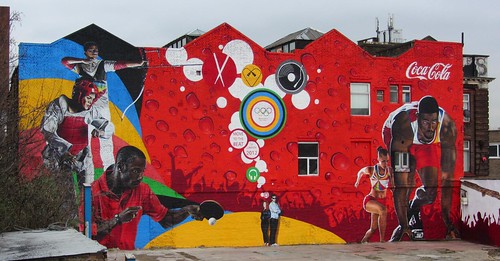 |
| Monorex, a photo by cocabeenslinky on Flickr. |
As you can see from these examples Coca Cola infuses its brand (bright red, vibrant, exciting) with the Olympic values and athletes. These variety of advertising campaigns correspond and follow the values the London 2012 Olympics wants to portray as the say on their website
"London 2012 will create the most accessible and participative Games. It will touch people as it has never done before, stimulating people to do more and to try new things and reassess what we are all capable of. London 2012 has sport at its heart and London at the centre, but it is more than London and more than sport. It is a Games for London, the UK and the rest of the world, for sport and culture, for volunteers and business."However some their marketing campaigns have met criticism, for example on Flickr one user said in regards to cocabeenslinky's photo:
"It should never have been there. What was there before was so much greater"
Despite this the marketing campaigns have been successful with their Youtube channel having over 60,986,548 views (as of 23:52pm on 05/03/2012) with their combination of brand identity, entertainment and celebrity. Being the only TOP to focus on drinks their exclusivity to the games provides a large point of revenue and something their competitors don't have. The only other food and drink company in the TOP's is McDonald's who themselves stock Coca Cola products.
Coca Cola as a business is fully aware of an evolving global economy and the up rise of social media and technology with their marketing director Claudia Navarro saying in Adage's article published in September 2011 on the release of their advertising campaign:
Coca Cola as a business is fully aware of an evolving global economy and the up rise of social media and technology with their marketing director Claudia Navarro saying in Adage's article published in September 2011 on the release of their advertising campaign:
"We are using London's rich culture and diversity as a backdrop. We've partnered with Mark Ronson because he's someone special - he's a London icon who can bring our creative vision to life. The athletes only met for the first time yesterday, but already they are buddies and are tweeting each other"This shows an understanding of social media, global relations, creativity and celebrity that each sponsor replicates throughout their Olympic campaigns.
What kind of companies are represented in London 2012?
 |
| Breakdown of companies - Pie chart generated by me through Chartgo |
In the previous spreadsheet worldwide partners were categorised by sort of companies they were. From this information a pie chart was generated to visualise percentages and what kind of company was most dominant within this group.
From this pie chart it is apparent that technological companies are the most represented within this selection. This coincides with an innovative perspective the games is trying portray. Additionally there is also a wide selection of other types of companies represented.
So from this further investigation which originated from a culmination of a wide variety of information I was able to find out reasoning behind marketing campaigns, the history of the Olympic games and how all this is all incorporated in certain brands. It is clear that branding both within the companies and within the Olympics is essential to a successful Olympic games if success is measured by a bigger spectacle, consumption, finance and audience satisfaction.
These forms of investigations and visualisations can be replicated to any pieces of information and any investigation by using specific Google searches/Google documents and websites such as Gliffy, Dipity and ChartGo.
These forms of investigations and visualisations can be replicated to any pieces of information and any investigation by using specific Google searches/Google documents and websites such as Gliffy, Dipity and ChartGo.


